viernes, 7 de octubre de 2016

HOW DIVE BIRDS WITHOUT BREAKING THE NECK

The brown pelican, cormorants, loons, gannets or the loons. 
These are some of the birds that can exceed 80 km / h when diving into the water to search for prey. According to the jumpers circuit Red Bull, which reach similar speeds to jump from almost 30 meters, if the input is clean hardly feel the impact (they have a water jet that breaks the surface tension and lessens the blow considerably) but if the input is bad, "it is like Mike Tyson gave you full".
  
Resultado de imagen de pelicano marron Resultado de imagen de cormorantsResultado de imagen de loons

But birds do normally always head and despite the thinness of his neck. "We were interested to see what happens when objects are immersed in water - explains Sunny Jung, one of the authors of the study published in Proceedings of the National Academy of Sciences of the United States of America -., So we looked for examples in nature In this regard, gannets are amazing. "Jung is an expert in the field of fluid mechanics and has published so ... striking a study on the system using dogs to drink, another on how to float flowers and even one called dynamic fluid under pressure: clap your hands are wet.

Jung's team focused on investigating the biomechanics of gannets diving and discovered that both the shape of the head, neck, as the length of the muscles work together to ensure that the impact with the water does not cause damage.

To analyze the accurately as possible, they used a booby rescued by the Museum of Natural Sciences North Carolina and counted 3D replicas of the skulls provided by the Smithsonian Institute. The results showed that the main force acting on the head of alcatraz, is friction, but the geometry of the head, neck length and shape of the peak, reduces this friction when compared to other birds "says Jung.

http://www.quo.es/ciencia/como-se-zambullen-las-aves-sin-romperse-el-cuello

Glossary: 

-The brown pelican: It is a subspecies of brown pelican (Pelecanus occidentalis), a bird belonging to the family of pelicans (Pelecanidae) inhabiting, with several subspecies, in the coasts of America from southern United States to Brazil. This subspecies is found on the islands and coasts of tropical America that bathes the Pacific Ocean.

Cormorant: is a family of some 40 species of aquatic birds commonly known as cormorants and shags. Several different classifications of the family have been proposed recently, and the number of genera is disputed. There is no consistent distinction between "cormorants" and "shags" as these appellations have been assigned to different species randomly.

Analysis:

In my opinion this new it's so interesting because these type of birds do things that the humans or other type of bird can't do. 
They do this because they are searching from prey so it's so important doing these things to supervive. 


jueves, 6 de octubre de 2016

The Memories deleted by the Alzheimer's can recover

The Memories deleted by the Alzheimer's can recover

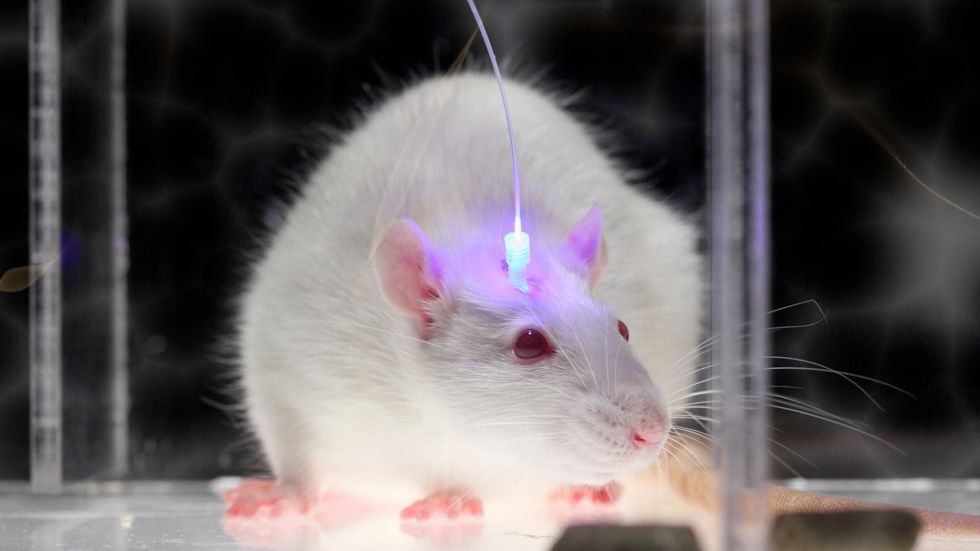
This is the name of the article, on an experiment done to mice by bursts of light in the brain. For the experiment took two groups of mice a few healthy and other genetically modified for suffering from the early stages of Alzheimer's, they placed the mice in a passenger compartment whose soil blew electric shock.
As was to be expected, after spending several days sick mice had forgotten the electric shock that had received previous days, while the non-ill reminded the jolt with Fear.
As gave an expected result decided to try another method. In this entered the game in the optogenética, inserts, using viruses, algae genes sensitive to light in the brains of mice. To mark these specific cells and powering them with bursts of light, mice with Alzheimer's returned to recall the electric shock. This means that if a memory seems to have vanished, is still there and the only thing difficult is to know how to retrieve it from all.
However to turn the light off the rescue of the memories are suspended, the result of this experiment was that the long-term sick mice recovered memory and were well as normal mice.

''Even if a memory seems to have vanished, still there. The problem is how to retrieve it'' 
16 MAR 2016

Link :
http://elpais.com/elpais/2016/03/16/ciencia/1458131857_131609.html?rel=mas?rel=mas

Opinión personal: I believe that this experiment with pets is a great step forward for the science and i am in favor of this as long as the animals do not suffer. In addition the Alzheimer's for me, is one of the worst diseases, not to say the worst. Has affected more than 8,000 Spanish people and not remember moments of your life is very hard because the basis of life is that, Live live and live to build a tomorrow. I only hope that some day a cure is found for humans and it disappears this disease


GLOSARIO
passenger compartment -> habitáculo : Coarse and senzillo space/ espacio tosco y senzillo


(I have not found more words, because I understand the news as I have done with my words)

THE EVOLUTIONARY HISTORY OF THE PRIMATES EXPLAINS THE VIOLENCE IN HUMANS


THE EVOLUTIONARY HISTORY OF THE PRIMATES EXPLAINS THE VIOLENCE IN HUMANS

Synopsis

The psychological, sociological and evolutionary roots of violence in humans is still under study.
The fact of being part of a group of mammals who are specially violent encourage us to have aggressive behaviour.

Humans can be six times more violent than other species, seen from an evolution perspective.
In total we have collected data of four million of lethal attacks between members of the same specie.
These attacks include war, homicide, infanticide and cannibalism.
Results show that letal violence is more common in territorial species and in species that live in social groups. In humans you combine both, that can explain our level of violence.

The level of violence has changed over the years of human history. Aggressive behaviour was common in prehistorical communities, now, in the modern times violence has decreased but that also depends of the sociopolitical condition we live in.

This study doesn't includes violence between other species because in that case we would be talking about survival.

The new investigation places the analysis of violence in the family tree of mammals like a feature that has developed over the years in evolution.
This subjected has been motive of a lot of philosophicals and cientific discussions over the centuries.
Thomas Hobbes thought we were violent by nature and Jacques Rousseau thought that the influence of society made us bad.


Link

http://www.lavanguardia.com/ciencia/planeta-tierra/20160929/41648841184/historia-evolucion-primates-violencia-humanos.html


Glossary

- Primates : member of the most developed and intelligent group of mammals, including humans, monkey and apes 


- Mammal : an animal that drinks milk from its mother's body when it is young.


- Species : a group of plants or animals that are the same in some way.


- Aggressive : angry and violent towards another person.


- Philosophical : relating to the study or writing of philosophy


- Survival : the state of continuing to live, specially after a dangerous situation.


Scientific scope

Biology, the evolution of the primates and violence.

Date 

29/09/201

Analysis


I think this news it's very interesting because this subject has been talked a lot during the years.
From my point of view I think like the author of the news, people in general are aggressive, it also depends in the sociopolitical condition you live in that makes you more or less aggressive but either that we are violent.
In my enviorment almost every day there is a violent behaviour among us.
I also agree with the study that demostrates that from an evolution perspective we are much more aggressive than other species, sometimes we are cruel to other species like for example the hunt of seals, but this study and news talks about the violence between us and we all can demostrate it's true just look in your surrounding.